


Online Stock Trading & Investing

Investing and Trading. Built for Indian Markets.
Dream. Trade. Rise


Existing User? Trade Now


Existing User? Trade Now
Discover Opportunities
Across the Market
Browse stocks across sectors, market caps, and indices to build watchlists for trading or long-term investing.
Filter by
Alphabetical Order
NSE
Sector

Market Cap
Your First Trade
Starts Here
Browse stocks across sectors, market caps, and indices to build watchlists for trading or long-term investing.


Open Your Demat Account
Complete your online KYC using PAN, Aadhaar, and bank details with quick digital verification.


Add Funds
Transfer money securely via UPI, net banking, or IMPS with instant balance reflection.


Find Stocks & Place Trades
Search stocks, view prices, and place delivery or intraday orders in seconds.


Track Portfolio & Reports
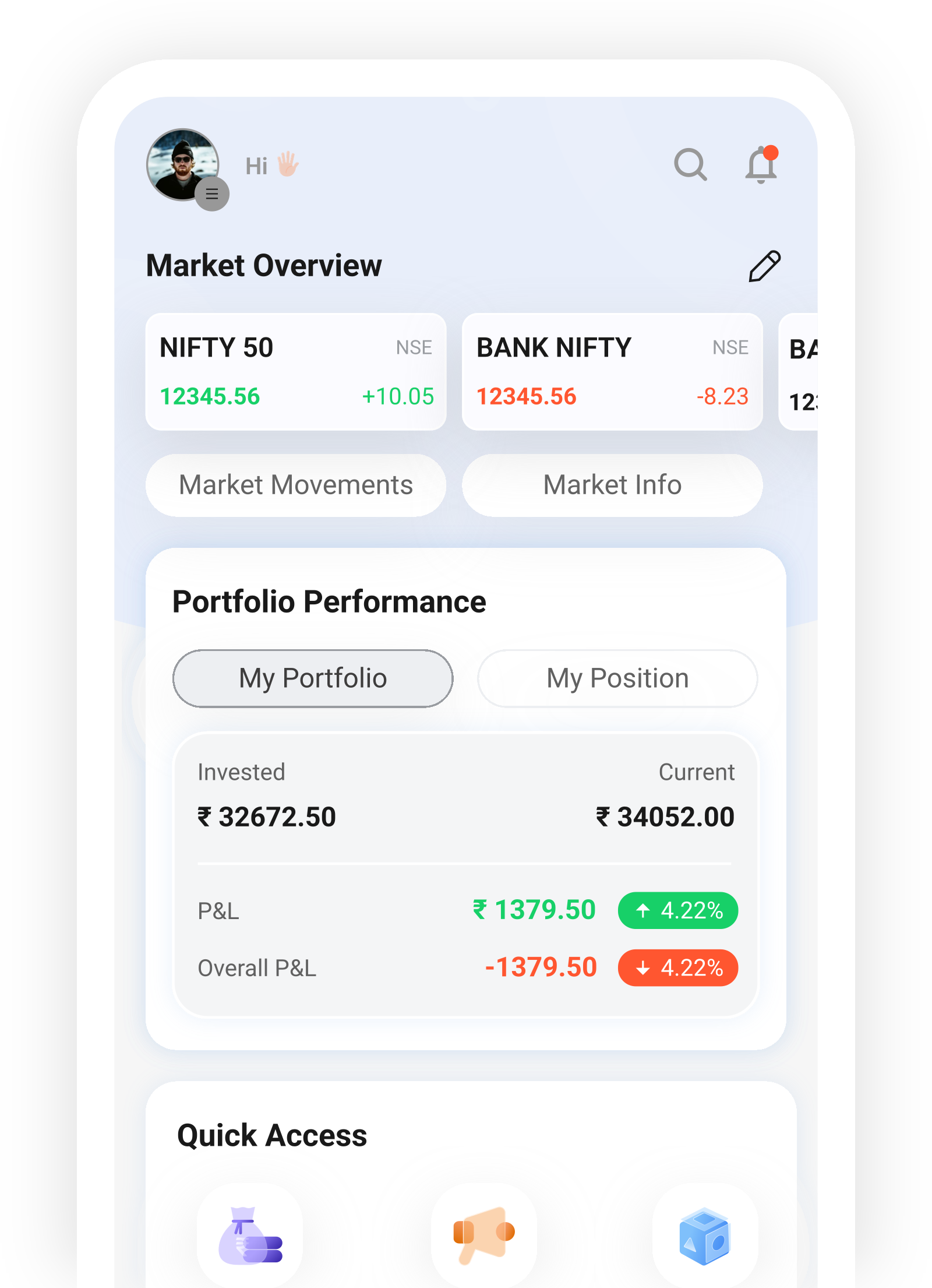
Monitor holdings, P&L, transaction history, and tax-ready reports from one live dashboard.

Stock Market
Education for Beginners
Learn what the stock market is, how stock trading works in India, and how to start investing with confidence.
What Is the Stock Market?
The stock market is a regulated platform where investors buy and sell shares of publicly listed companies. In India, stock trading happens mainly on the NSE (National Stock Exchange) and BSE (Bombay Stock Exchange). Investors participate in the stock market to grow wealth, earn dividends, and benefit from long-term economic growth.
What Are Stocks and Shares?
Stocks (also called shares) represent ownership in a company. When you buy a company's stock, you become a shareholder and own a portion of that business. Shareholders can earn returns through stock price appreciation and dividend payouts.
How Does Stock Trading Work in India?
Stock trading in India is done through a SEBI-registered stock broker using a demat and trading account.
Here's how it works:
1. You place a buy or sell order through a trading platform
2. The order is sent to NSE or BSE
3. The exchange matches your order with a counterparty
4. Shares are credited or debited from your demat account
Trading can be done at market price or at a limit price chosen by you.
Investing vs Trading in the Stock Market
Stock Investing
• Long-term approach
• Focus on company fundamentals
• Goal is wealth creation over years
Stock Trading
• Short-term buying and selling
• Focus on price movements
• Goal is quick profits from volatility
Both styles require different strategies, time commitment, and risk tolerance.
Types of Stock Trading in India
Delivery Trading – Buy and hold stocks for long-term investment.
Intraday Trading – Buy and sell on the same day before the market closes.
Swing Trading – Hold stocks for a few days to weeks.
Position Trading – Hold stocks for weeks or months based on long-term trends.
Charges Involved in Stock Trading
When you trade stocks, the following charges apply:
• Brokerage – Fee charged by your stock broker
• STT (Securities Transaction Tax) – Government tax on stock trades
• GST – Applied on brokerage and exchange charges
• Exchange Charges – NSE/BSE transaction fees
• Stamp Duty – State government tax on transactions
Understanding charges helps you calculate your actual profit or loss correctly.
Benefits of Investing in Stocks
• High potential for long-term returns
• Protection against inflation
• Dividend income from profitable companies
• High liquidity – easy to buy and sell
• Portfolio diversification across sectors
Important Stock Market Terms for Beginners
• Market Capitalization – Company's total market value
• 52-Week High/Low – Highest and lowest price in one year
• PE Ratio – Stock valuation based on earnings
• Volume – Total shares traded
• Dividend Yield – Annual dividend income percentage
How to Invest in Stocks – Step-by-Step
1. Open a demat and trading account
2. Add funds to your trading account
3. Research and select stocks
4. Place your buy order
5. Track your portfolio and rebalance when needed
What Is the Stock Market?
The stock market is a regulated platform where investors buy and sell shares of publicly listed companies. In India, stock trading happens mainly on the NSE (National Stock Exchange) and BSE (Bombay Stock Exchange). Investors participate in the stock market to grow wealth, earn dividends, and benefit from long-term economic growth.
What Are Stocks and Shares?
Stocks (also called shares) represent ownership in a company. When you buy a company's stock, you become a shareholder and own a portion of that business. Shareholders can earn returns through stock price appreciation and dividend payouts.
How Does Stock Trading Work in India?
Stock trading in India is done through a SEBI-registered stock broker using a demat and trading account.
Here's how it works:
1. You place a buy or sell order through a trading platform
2. The order is sent to NSE or BSE
3. The exchange matches your order with a counterparty
4. Shares are credited or debited from your demat account
Trading can be done at market price or at a limit price chosen by you.
Investing vs Trading in the Stock Market
Stock Investing
• Long-term approach
• Focus on company fundamentals
• Goal is wealth creation over years
Stock Trading
• Short-term buying and selling
• Focus on price movements
• Goal is quick profits from volatility
Both styles require different strategies, time commitment, and risk tolerance.
Types of Stock Trading in India
Delivery Trading – Buy and hold stocks for long-term investment.
Intraday Trading – Buy and sell on the same day before the market closes.
Swing Trading – Hold stocks for a few days to weeks.
Position Trading – Hold stocks for weeks or months based on long-term trends.
Charges Involved in Stock Trading
When you trade stocks, the following charges apply:
• Brokerage – Fee charged by your stock broker
• STT (Securities Transaction Tax) – Government tax on stock trades
• GST – Applied on brokerage and exchange charges
• Exchange Charges – NSE/BSE transaction fees
• Stamp Duty – State government tax on transactions
Understanding charges helps you calculate your actual profit or loss correctly.
Benefits of Investing in Stocks
• High potential for long-term returns
• Protection against inflation
• Dividend income from profitable companies
• High liquidity – easy to buy and sell
• Portfolio diversification across sectors
Important Stock Market Terms for Beginners
• Market Capitalization – Company's total market value
• 52-Week High/Low – Highest and lowest price in one year
• PE Ratio – Stock valuation based on earnings
• Volume – Total shares traded
• Dividend Yield – Annual dividend income percentage
How to Invest in Stocks – Step-by-Step
1. Open a demat and trading account
2. Add funds to your trading account
3. Research and select stocks
4. Place your buy order
5. Track your portfolio and rebalance when needed
FAQs
The stock market is where investors buy and sell shares of listed companies. In India, trading happens on BSE and NSE, where prices move in real time based on demand, supply, news, and overall Indian stock market sentiment.
You can track NSE live, BSE live, and individual share prices through online trading platforms. These show real-time movements of stocks and indices, helping you follow the share market live during market hours.
The share market today and stock market live charts display real-time price movements, volume, and trends. A share market live chart today helps traders and investors understand how the Indian market is performing throughout the day.
Stock market today India refers to the current condition of Indian markets, including major indices and stocks. It reflects how global cues, economic updates, and investor activity are impacting the Indian share market on that day.
BSE (Bombay Stock Exchange) and NSE (National Stock Exchange) are India’s two main exchanges. Both list the same major stocks, but prices can differ slightly due to trading volume and liquidity. Investors often track BSE NSE together for a complete market view.
What are you waiting for?
Join the club of zero fees and infinite possibilities. Jump into action now!


What are you waiting for?
Join the club of zero fees and infinite possibilities. Jump into action now!